Why Nursing Students Need High-Performance Tech for Virtual Simulations

The landscape of medical education has shifted dramatically. If you walked into a nursing lab ten years ago, you’d see plastic mannequins and stacks of paper charts. Today, that same lab is likely a digital hub. Nursing students in 2026 are increasingly trading physical classrooms for immersive virtual simulations (vSims) that mimic real-life clinical scenarios. While these tools offer a safe space to make mistakes, they come with a catch: they require serious hardware.
For many, the transition to high-stakes digital learning can be overwhelming. Balancing clinical rotations with rigorous documentation and research is a massive undertaking. When the technical workload or the complexity of a case study becomes too much to handle alone, many students find that partnering with a reliable assignment helper from MyAssignmentHelp Services allows them to focus more on their practical skills while keeping their grades on track. Having a support system in place is just as important as having the right laptop.
The Rise of the Virtual Clinical: More Than Just a Game
Virtual simulations are not just glorified video games; they are data-heavy environments designed to test a student’s split-second decision-making. From VR (Virtual Reality) headsets that walk you through an ICU to software that tracks how accurately you calculate a medication dosage, these programs require high processing power.
If your laptop lags during a simulated cardiac arrest, you aren’t just losing time—you’re losing the rhythm of the learning experience. High-performance tech ensures that the graphics are fluid and the response times are instant, allowing the student to stay “in the zone” of the clinical environment.
Hardware Requirements for Modern Nursing Software
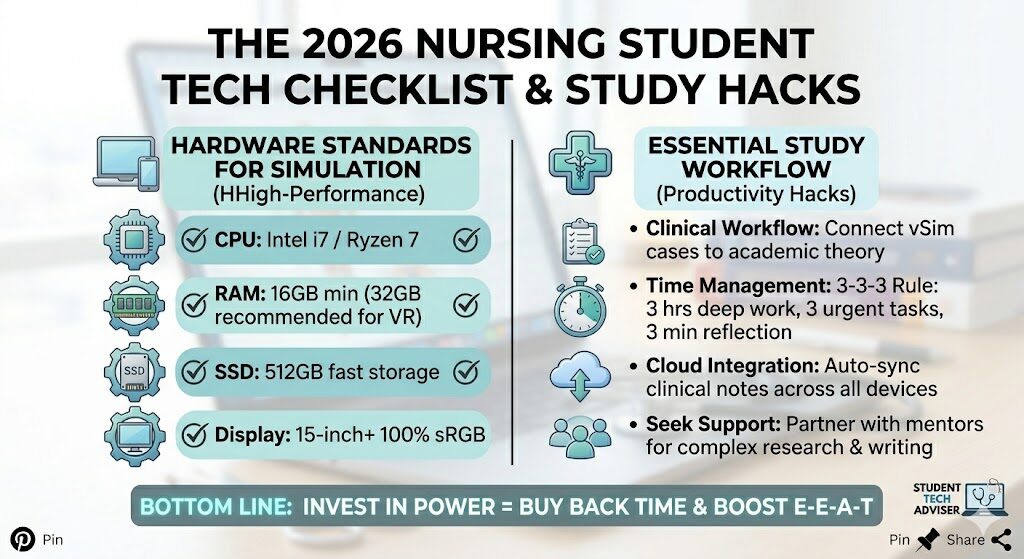
Most nursing students assume a basic Chromebook or an entry-level tablet will suffice. However, as software becomes more sophisticated, the minimum requirements are climbing. To run 2026-grade simulations without your fan sounding like a jet engine, you need specific internal specs.
| Component | Minimum Requirement | Recommended for Simulations |
| Processor (CPU) | Intel Core i5 or Ryzen 5 | Intel Core i7 or Ryzen 7 |
| RAM (Memory) | 8GB | 16GB |
| Storage (SSD) | 256GB | 512GB or higher |
| Graphics | Integrated HD Graphics | Dedicated GPU (NVIDIA/AMD) |
| Battery Life | 5 Hours | 8+ Hours (for long clinical days) |
Bridging the Gap Between Theory and Practice
One of the hardest parts of nursing school is the “translation.” You learn the theory in a textbook, you practice it in a virtual simulation, and then you have to write a 3,000-word evidence-based report on it. This is where the academic pressure often peaks.
Nursing is unique because it combines high-level science with empathetic care. Writing about these experiences requires a deep understanding of medical terminology and nursing frameworks. If you find yourself struggling to articulate your clinical findings, getting specialized help with nursing assignments through MyAssignmentHelp Services can provide the clarity needed to mirror the professionalism expected in the field. This ensures your written work is as sharp as your clinical performance.
Reducing “Digital Fatigue” in Healthcare Education
Nursing burnout often starts before the first job. It begins in the library at 2:00 AM. When your technology is slow, it adds a layer of “digital friction” to your life. A high-performance laptop reduces this friction. It opens documents faster, renders simulations smoother, and allows for seamless multitasking between a Zoom lecture, an e-textbook, and your research tabs.
By investing in quality tech, you are essentially buying back your time. That extra hour saved from waiting for software to load is an hour you can spend on self-care or extra sleep—two things nursing students desperately need.
The Role of AI and Machine Learning in Nursing Labs
We are seeing simulations that use AI to adapt to a student’s specific weaknesses. If the software notices you struggle with respiratory assessments, it will generate more “patients” with lung issues. These adaptive algorithms require a stable, powerful internet connection and a processor that can handle real-time data crunching.
Strategic Tips for Ranking Your Best Student Life
If you want to excel in 2026, you have to treat your education like a professional career. This means:
- Optimizing your workspace: Use a secondary monitor for your virtual simulations.
- Cloud Integration: Ensure all your clinical notes are synced across devices.
- Seeking Mentorship: Don’t be afraid to use academic resources when the technical writing gets dense.
Frequently Asked Questions (FAQ)
1. Why can’t I just use a tablet for my nursing simulations?
Ans: While tablets are great for reading and quick notes, most high-end simulation software is built for Windows or macOS. Tablets often lack the RAM needed to run complex 3D medical environments without crashing.
2. Is a dedicated graphics card really necessary for nursing?
Ans: It depends on your program. If your school uses VR (Virtual Reality) or high-fidelity 3D simulations, a dedicated graphics card will prevent lag and “motion sickness” caused by choppy frame rates.
3. How do I manage my time between clinicals and heavy writing assignments?
Ans: Use the “3-3-3” rule: Focus on 3 hours of deep study, 3 tasks that are urgent, and 3 minutes of reflection. If the writing load is still too much, professional academic services can help bridge the gap.
4. Will high-performance tech help with my NCLEX prep?
Ans: Yes. Modern NCLEX prep platforms use CAT (Computer Adaptive Testing) which runs much more efficiently on modern browsers and hardware, providing a smoother testing experience.
About The Author
Hi, I’m Min Seow. I am a content strategist and researcher associated with MyAssignmentHelp, where I focus on bridging the gap between complex academic requirements and practical, high-impact learning strategies. My goal is to help students navigate the evolving landscape of higher education—specifically by integrating modern technology and efficient study habits into their daily routines.
